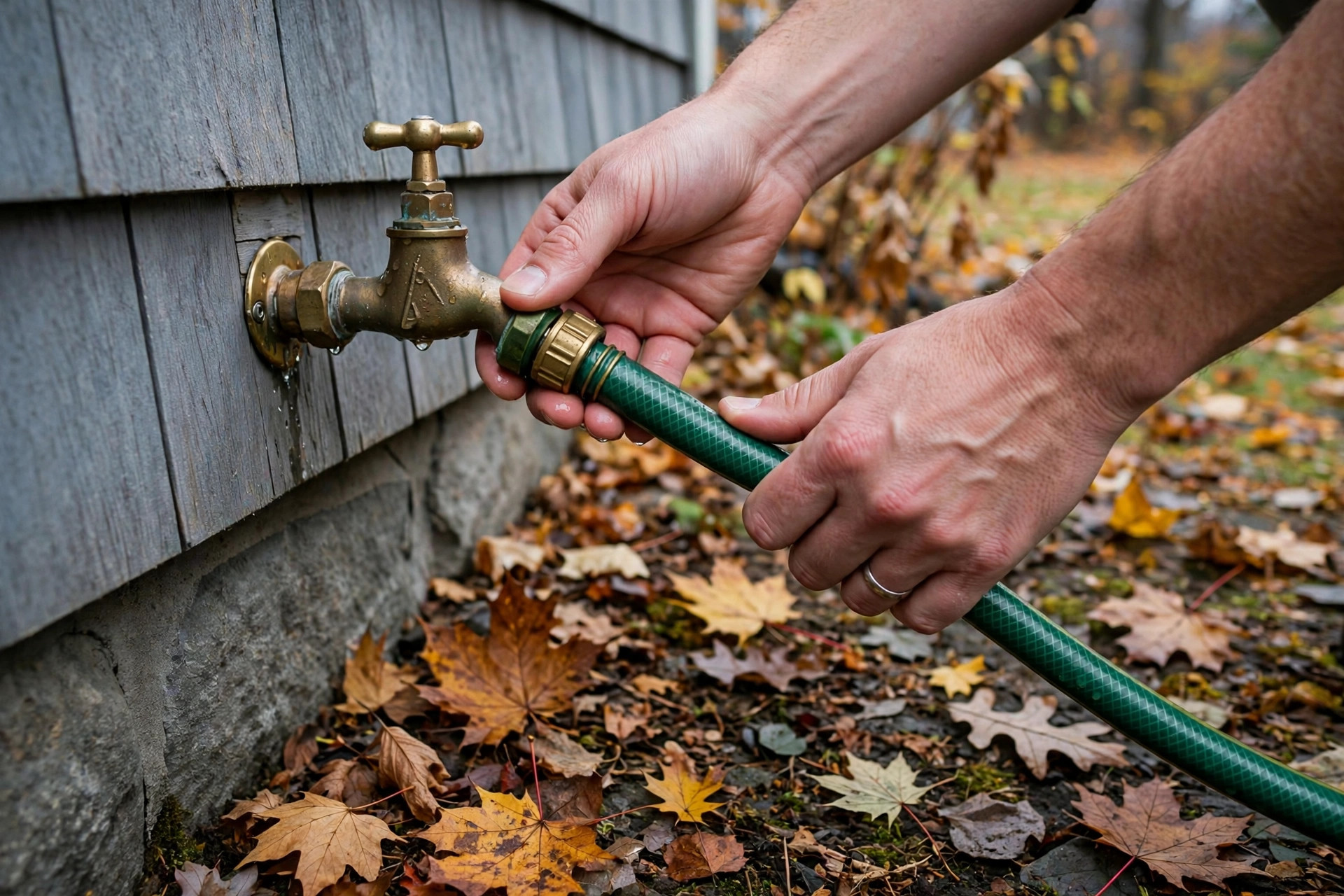
Tonight's low in Moncton is headed for 1°C, and by Tuesday night the forecast dips below freezing. That is your cue: if your outdoor taps are still live, this is the weekend to shut them down. A burst outdoor pipe is one of the most avoidable repair bills in a New Brunswick winter — and it usually starts with a garden hose nobody got around to disconnecting.
Why a hose bib is the weakest link
An outdoor faucet sits on the cold side of your wall, and the short pipe behind it runs through the part of the house with the least insulation. When water trapped in that pipe freezes, it expands by about nine percent. The pipe does not always split where you can see it — it often cracks inside the wall, and the leak only shows up in spring when you turn the tap on again and water starts soaking into insulation, drywall, or the basement below. In a Moncton winter, where January nights routinely fall well below -10°C, that is a long time for a slow leak to do damage before anyone notices.
The five-minute shutdown, in order
- Disconnect every hose. Unhook hoses from all outdoor taps, drain them, and store them in the garage or shed. A hose left attached traps water in the faucet even on a frost-free tap — it is the single most common cause of a burst hose bib.
- Find the inside shut-off valve. In most Moncton-area homes it is in the basement, near the wall where the outdoor tap sits. Turn it clockwise until it stops. If you have more than one outdoor tap, check each one — they are not always on the same valve.
- Open the outdoor tap to drain it. With the inside valve closed, open the outside faucet and let the stub of pipe between the valve and the tap empty out. Some shut-off valves have a small bleeder cap — open that too and catch the drips in a bucket.
- Leave the outdoor tap open all winter. An open tap gives any leftover moisture room to expand instead of pressing against a closed valve and cracking the pipe.
- Add a foam faucet cover. An insulated cover costs a few dollars at any hardware store in town and keeps cold air off the spout through the worst cold snaps.
What about frost-free faucets?
Many newer homes in Moncton, Dieppe, and Riverview have frost-free sillcocks, where the valve actually sits deep inside the heated wall. They are a real improvement — but they only work if the hose is disconnected. With a hose attached, water stays trapped in the long stem, freezes, and splits the pipe exactly the same way. If you are not sure which kind you have, do the full shutdown anyway: it costs nothing and it covers both types.
💡 Don't forget the rest of the outdoor water
The same weekend, drain the irrigation lines or shut off the sprinkler timer, empty the rain barrel, and bring in the pressure washer. Anything holding water outside the house is on the same clock as the hose bibs.
Rentals and older homes need extra attention
Landlords, this one is on your checklist too: a vacant unit or a tenant who has never winterized a tap is how burst pipes happen in rental stock. Older homes around Moncton — the post-war bungalows and the century homes in the older neighbourhoods — often have their outdoor lines running through unheated crawl spaces, where a single hard freeze is enough. If you cannot find the inside shut-off, or the valve is seized and will not turn, that is a quick job for a plumber before the cold sets in, not a spring emergency call. Do it on a mild Saturday now, while the taps are still easy to reach and nobody is standing in snow to find them.