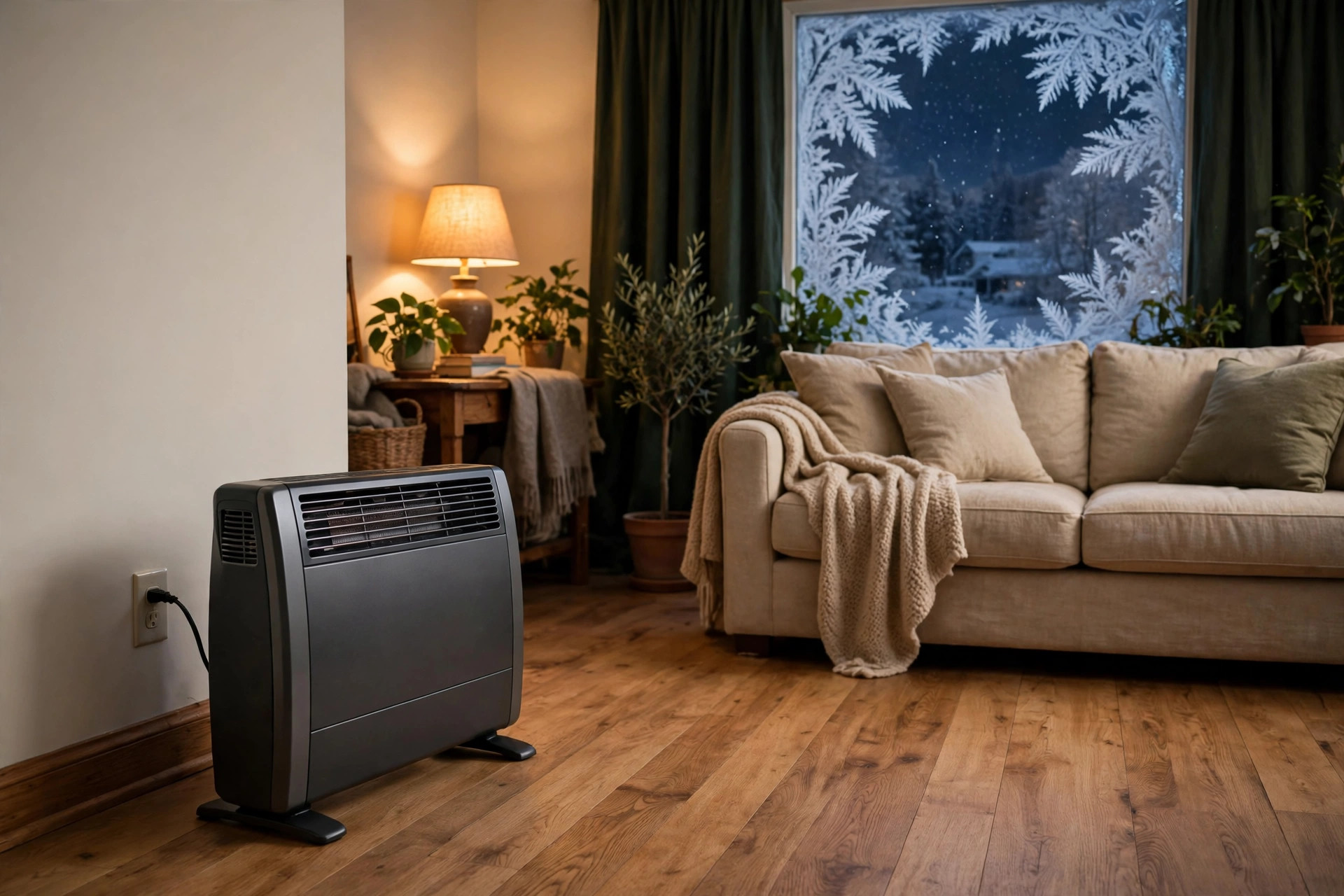
The first cold week in Greater Moncton sends the same appliance out of the closet in thousands of homes: the portable space heater. It's also where a quiet season of electrical problems starts. Health Canada recorded 252 reported safety incidents involving portable electric heaters between 2011 and 2023, including 5 deaths — and most of them trace back to how the heater was plugged in and where it was sitting, not the heater itself.
The one rule that matters most
Plug the heater directly into a wall outlet. Never an extension cord, never a power bar, never a plug splitter. Electrical safety authorities are blunt about this one, and here's the arithmetic behind it: a typical heater draws about 1,500 watts, which is roughly 12.5 amps on a standard 15-amp household circuit. That is nearly the entire circuit, sustained for hours. Extension cords and power bars aren't built to carry that load continuously — they heat up slowly, behind furniture, where nobody notices until the insulation melts.
One heater per circuit — and know your circuit
Because a heater nearly maxes out a circuit by itself, whatever else shares that circuit matters. A heater plus a kettle, a microwave, or a second heater on the same run is how breakers start tripping — and a breaker that trips repeatedly is information, not an annoyance to work around. If your panel still runs on fuses, or breakers trip whenever the heater runs, that's the house telling you the circuit is at its limit.
Placement: the metre rule
- Keep at least 1 metre (3 feet) of clearance on all sides — curtains, bedding, sofas, paper, laundry baskets. Most heater fires start with something combustible too close, not with a malfunction.
- Flat, hard floor only. Never on a bed, a rug piled with blankets, or up on furniture where it can tip. Buy (or keep) only heaters with tip-over and overheat shut-off switches.
- Out of walkways. Not in doorways or hallways where the cord becomes a trip hazard — and never run the cord under a carpet, where damage hides and heat builds.
- Check the certification mark. The heater should carry a recognized Canadian approval mark (CSA or equivalent) on the label. No mark, no plug-in.
💡 The two-minute cord check
Before the first use of the season, run the cord through your hands. Stiff, cracked, or frayed insulation, a plug that sits loose in the outlet, or scorch marks on either means the heater is done — retire it. And feel the plug after the heater has run for twenty minutes: warm to the touch is a warning sign worth taking seriously.
When it's not the heater — it's the house
Sometimes the heater gets blamed for what the wiring is doing. Outlets that are warm with nothing heavy plugged in, lights that flicker when the heat kicks on, a burning smell near the panel, or a breaker that won't stay reset are all get-it-looked-at-now items, heater or no heater. Older Moncton homes with 60-amp services or fuse panels feel space heater season first.
Run the heater in the room you're in, turn it off when you leave or go to sleep, and give it a circuit it doesn't have to share. Do those things and the cheapest heat in the house stays what it should be: boring.