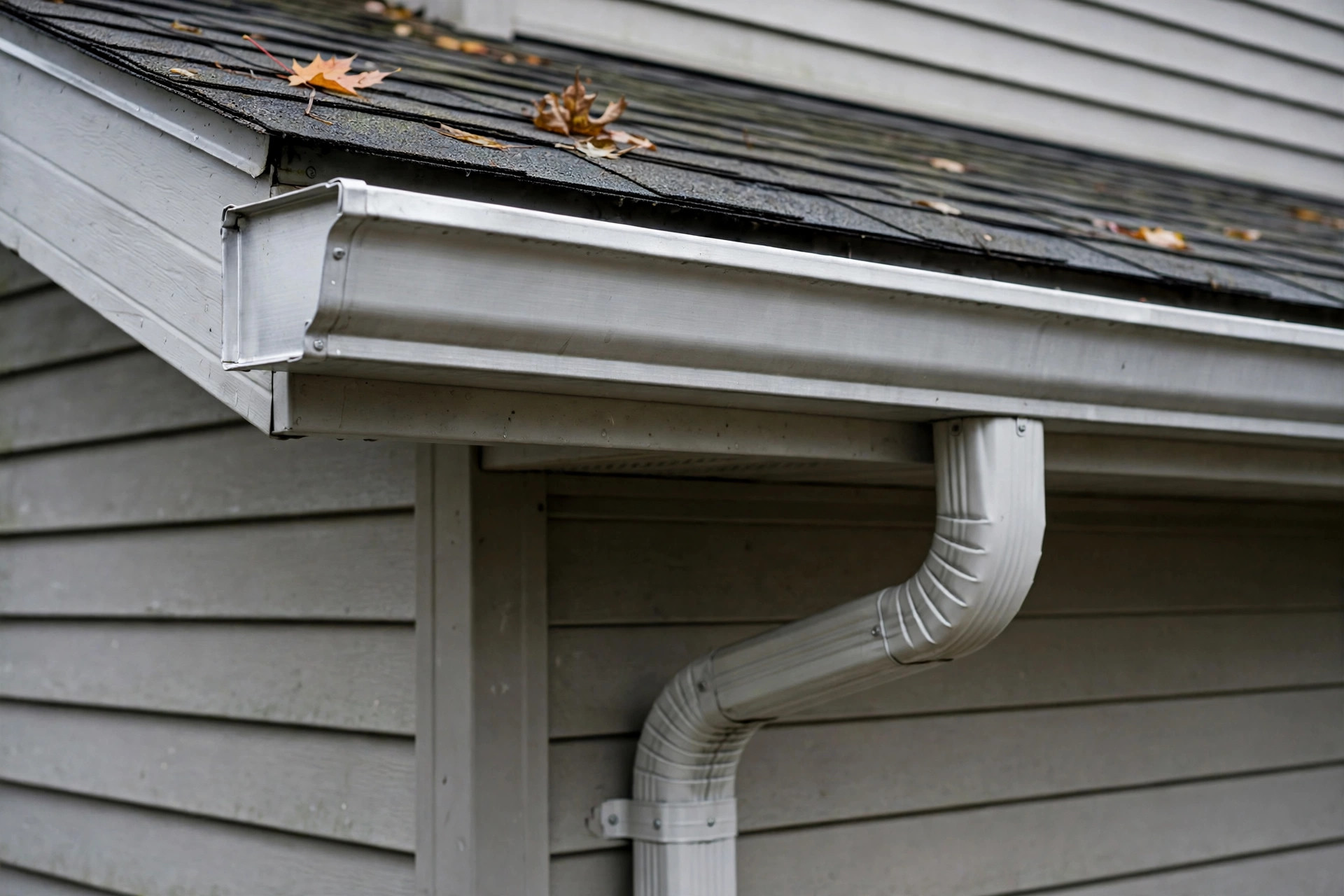
Moncton woke up below freezing this morning, and that is your warning shot. Your eavestroughs have one job all winter — move water off the roof and away from the house — and the week or two before the first hard freeze is the last easy chance to make sure they can do it. Wet leaves in late October become ice in January, and ice does not drain.
Why a clogged trough is a winter problem, not a spring one
When a trough is blocked, rain and meltwater have nowhere to go. It spills over the edge and runs down the siding, soaks the fascia boards, and pools beside the foundation. Then the temperature drops, and that trapped water freezes and expands. Seams split, brackets strain under the weight, and downspouts can crack at the elbows. Come the spring thaw, it finds its way into basements and behind siding.
The other winter headache starts on the roof itself. Heat escaping through a poorly insulated attic melts snow near the peak; the meltwater runs down to the cold eaves, refreezes, and builds an ice dam. Water then pools behind that dam and can creep under the shingles and into the ceiling. Clean troughs do not prevent ice dams on their own — attic insulation and ventilation are the real long-term fix — but a blocked trough makes every freeze-thaw cycle worse, and Moncton gets plenty of those.
When to do it in Moncton
Wait until most of the leaves are down, but do not wait for the first hard freeze. On the older, treed streets of Moncton, Dieppe and Riverview, and around Shediac and Sackville, that window usually lands in late October. Clean too early and a week of falling leaves fills everything again. Clean too late and you are scooping frozen sludge off a ladder in the cold.
Work through it in this order
- Scoop the troughs first. Work toward the downspout. Leaves, twigs, shingle grit and the black muck underneath all have to come out — the muck is what holds water against the metal all winter.
- Flush with a hose. Run water from the end farthest from the downspout and watch it come out the bottom. If it trickles or backs up, the downspout is blocked — a plumber's snake or a careful blast from the hose usually clears it.
- Check the slope and the hangers. Troughs need a slight downhill run toward the downspout, or water sits and freezes in place. Look for sections that sag or pull away from the fascia, and tighten or replace loose brackets now. A full trough of ice is heavy, and weak fasteners fail mid-storm.
- Seal the seams. Drips at joints and end caps are small in October and destructive by February, when every drip becomes an icicle that pries the joint open. Gutter sealant on a dry day fixes most of them.
- Finish at the ground. Downspouts should carry water well away from the foundation — several feet at minimum — and the soil beside the house should slope away, not toward it. Extensions kicked aside during summer yard work are the easiest fix on this whole list.
An honest word about gutter guards
Guards and screens cut down on leaf buildup, and on a heavily treed lot they earn their keep. But they are not a fit-and-forget solution, and they do not stop ice dams — if attic heat is melting snow on your roof, the problem is upstairs, not in the trough. Fine mesh keeps out pine needles and grit; foam inserts and brush guards need replacing every few years. Whatever you have, it still deserves a look before winter.
Ladders, and when to hand it over
Single-storey troughs are a reasonable job with a stable ladder, a spotter, and dry footing. Two-storey work, steep roofs, or troughs already pulling away from the house are where a professional is cheaper than a fall. And never work on a ladder when it is icy, or chip ice out of a frozen trough: you will likely crack the trough or dent the aluminum instead.
💡 The five-minute test after the next rain
After the next rain, walk around the house. Water should pour from every downspout and land well clear of the foundation — no overflow, no drips at the seams, no puddle against the wall. If you see overflow in one spot, that is the section to revisit before the cold locks it in.
Moncton's first snow usually holds off until late November, which means there is still time to get this right. An afternoon on the troughs now is the difference between a roofline that sheds winter and one that stores it.